In the highly competitive world of field service, the efficiency and effectiveness of your ticket workflows can directly impact your bottom line. For machinery manufacturers, suppliers and OEMs, improperly structured service tickets can lead to lost revenue, increased downtime, and frustrated customers.
A well-designed ticket workflow does more than just capture issues; it transforms raw customer interactions into actionable tickets that streamline the resolution process.
In this article, we will explore the principles of creating context-driven OEM ticket workflows, focusing on structured intake processes to enhance the customer experience, improve resolution times, and ultimately lead to a more efficient service operation.
By the end, you will have a clear roadmap to implement OEM ticket workflows that preserve context, reduce handoff friction, and support scalable field service operations.
.png)
What Is a Ticket Workflow in Field Service?
A ticket workflow is a structured process that transforms a customer’s inquiry into a resolved issue efficiently.
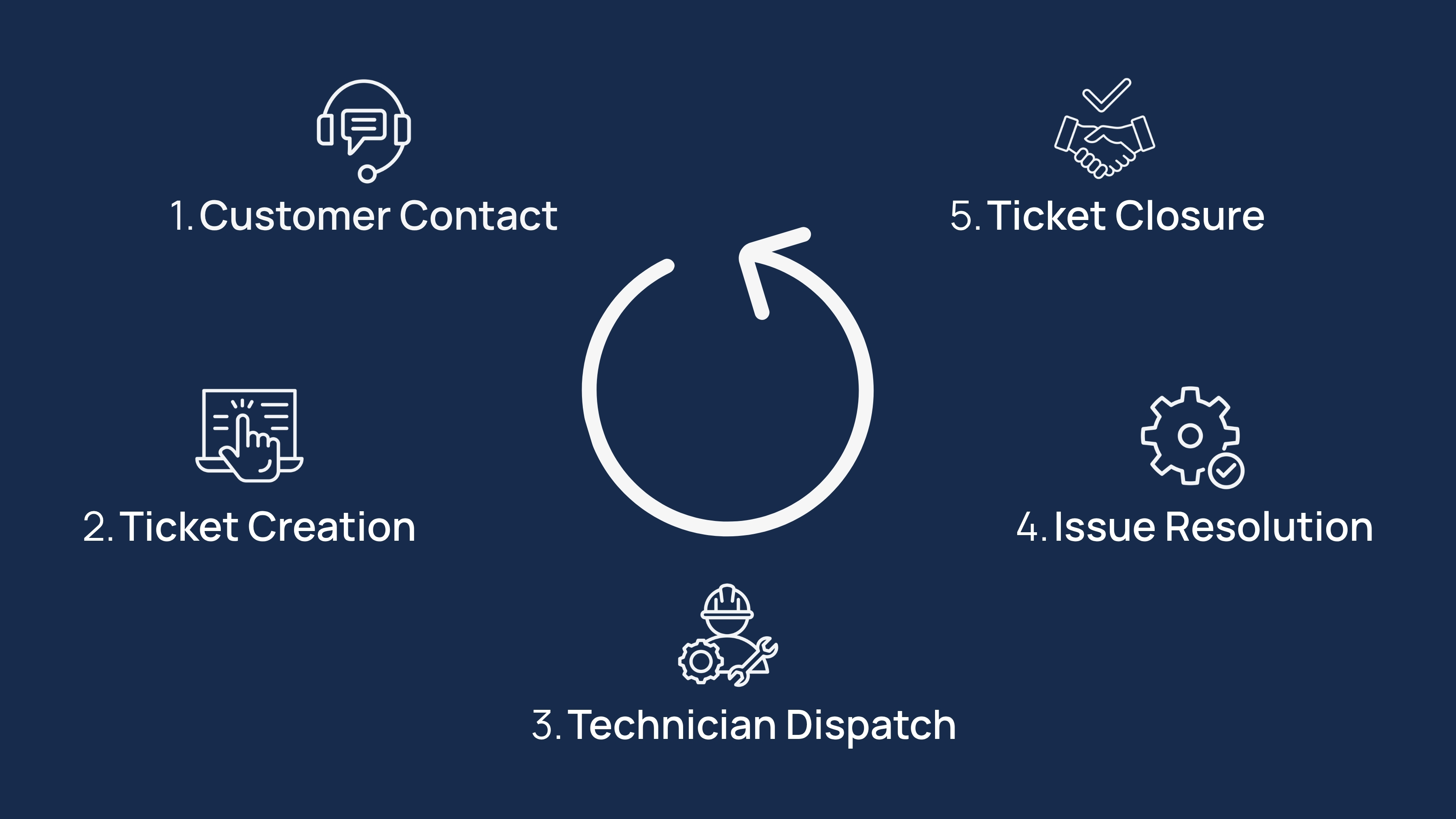
It typically follows a linear path:
- Customer Contact: The initiation of a service request through various channels.
- Ticket Creation: The conversion into a structured ticket capturing vital details.
- Technician Dispatch: Sending the ticket to the appropriate technician.
- Issue Resolution: Addressing the issued ticket by a technician.
- Ticket Closure: Finalising the ticket, documenting the resolution, and recording feedback.
While many businesses utilise basic ticketing systems, OEM-grade field service workflows are designed to handle complexities involving installed bases, spare parts management, and various SLAs across multiple teams.
A robust ticket workflow incorporates real-time data and analytics, providing valuable insights into operational efficiency, customer satisfaction, and team performance.
Read more: 8 Best Field Service Ticketing System in 2026
Why Context Matters in OEM Ticket Workflows
In the realm of field service, the importance of context cannot be overstated. When ticket workflows lack the necessary context, issues arise such as:
Loss of Tribal Knowledge:
Experienced technicians may leave, taking valuable information with them.
Context-Driven Escalations:
Tickets might escalate without technicians fully understanding the situation, wasting time and resources.
Repeated Diagnostics:
Technicians often find themselves asking the same questions that could have been answered upfront, leading to inefficient resolutions.
A context-driven ticket workflow incorporates essential information, who the customer is, what equipment is involved, the specific symptoms reported, actions taken to troubleshoot, and the business impact of the issue.
By integrating installed-base data and AI-assisted notes, OEMs can greatly reduce knowledge loss during handoffs and enhance service delivery quality.
Read more: Field Service Ticketing & Help Desk Software for Machinery Manufacturers
Structured Intake: The Foundation of Context-Driven Tickets
At the heart of an efficient OEM ticket workflow lies structured dataintake. This process involves using guided digital forms, mandatory fields, and contextual data capture to streamline service requests. Key intake fields critical to OEMs include:
Implementing structured intake reduces the need for technicians to ask multiple questions upon arrival, thus accelerating the resolution process.
By collecting comprehensive context from the outset, OEMs can ensure their teams have all the information needed to address customer issues effectively. This approach aligns with best practices in help desk and ticketing systems tailored for field service.
Mapping Context Across Ticket Stages
The flow of context throughout the various stages of a ticket workflow is vital for seamless operation. Understanding this flow can help prevent information loss. Here’s how context moves through the ticketing process:
Customer Contact to Ticket Creation
Initially, the customer contacts the support team, leading to ticket creation. Here, detailed information should be captured, forming a sound foundation for the workflow.
Ticket Assignment and Routing
Here, the focus shifts to how tickets are assigned based on skills and territory, ensuring the right technician handles each ticket, whether it’s an OEM or distributor.
Field Technician Assignment and Mobile Intake
Technicians must have real-time access to ticket information, enabling them to gather additional data on-site and ensuring nothing is overlooked.
Escalation to Engineering or Specialists
In instances where issues are complex, tickets may need to be escalated to engineering. Context-rich workflows ensure that the engineering team has all requisite information, such as the affected production line.
Resolution, Closure, and Feedback
Finally, once a resolution is achieved, the ticket should be closed, documenting the solution and gathering customer feedback for service improvement.
Designing Context-Driven OEM Ticket Workflows: Step-by-Step
Creating effective OEM ticket workflows involves a few essential steps:
Step 1: Map Your Typical OEM Support Scenarios
Identifying common scenarios, such as a bottling line down at a key customer or preventive maintenance requests from distributors, sets the stage for understanding operational challenges.
Step 2: Define Mandatory Context Fields
Establish what fields are essential to capture critical information and ensure clarity in communications.
Step 3: Set Up Routing Rules Based on Context
Illustrate rules, e.g., if the issue is classified as “line-critical” and it’s night-shift time, then trigger a P1 field-service workflow to prioritise resolution.
Step 4: Enable Self-Service and Guided Workflows
Encouraging customers to utilise customer self-service portals with guided questions can enhance the initial reporting of issues.
Step 5: Automate Handoffs and Keep Context Visible
Ensuring that tickets flow smoothly from dealer to OEM and ultimately to engineering maintains visibility and reduces time delays.
Avoiding Common Pitfalls in OEM Ticket Workflows
While designing ticket workflows, OEMs should be wary of certain pitfalls:
• Treating Ticketing as a “Ticketing Tool”: Understanding that effective ticketing entails multiple workflow processes rather than a standalone tool is crucial.
• Overloading Unstructured Comments: Relying on vague comments rather than structured fields can leave too much to interpretation.
• Ignoring Dealer Handoffs and Visibility: Maintaining transparency throughout the process can prevent critical delays.
• No Structured Intake for Field-Service-Specific Context: Each machine or operational context has unique requirements that should inform the intake process.
How Makula Field Service Enables Context-Driven OEM Ticket Workflows
Makula Field Service is designed to transform generic service tickets into context-rich workflows. It integrates seamlessly with your help desk and ticketing processes.
How to Measure the Success of Your Ticket Workflows
Measuring the success of your OEM ticket workflows is essential to confirm that your context-driven design and structured intake processes deliver real value.
Without clear, quantifiable metrics, even well-designed workflows can conceal inefficiencies such as hidden handoff delays, repeated site visits, or SLA breaches that damage customer trust and increase operational costs.
In field service, where technicians work remotely and equipment downtime directly impacts production lines, these metrics act as leading indicators of operational health.
Below are four core key metrics for context-driven OEM workflows, each with a clear explanation, practical example, and calculation formula:
1. First-Contact Resolution Time (FCR Rate):
This metric assesses how quickly and completely issues are resolved during the initial interaction or first technician visit, without requiring follow-ups, escalations, or ticket reopenings.
Example & Formula:
In a month, your team handled 200 tickets. Of these, 140 were fully resolved on the first technician visit with no further action needed.
FCR Rate = (Number of tickets resolved on first contact ÷ Total tickets handled) × 100 → (140 ÷ 200) × 100 = 70%.
Industry benchmarks for field service typically range from 65–80%; top-performing OEMs aim for 75%+ through rich contextual data.
2. Mean Time to Dispatch:
This measures the average time taken from ticket creation to assigning and notifying the appropriate field technician. Efficient dispatch is a direct outcome of context-driven routing rules (e.g., skill-matching, territory, equipment type, and urgency).
Delays here multiply downtime, especially for critical production assets. Strong structured intake accelerates this stage by providing clear prioritisation signals.
Example & Formula:
Over a week, 50 tickets were created with a combined dispatch waiting time of 1,250 minutes (from creation to technician acknowledgment).
Mean Time to Dispatch = Total dispatch waiting time ÷ Number of tickets → 1,250 ÷ 50 = 25 minutes.
Aim to keep this under 30–60 minutes for P1/P2 tickets; longer times indicate gaps in automated routing or missing context triggers.
3. Ticket Re-Open Rate:
This tracks the percentage of tickets that are reopened after being marked as resolved, signaling that the initial fix was incomplete or context was lost during handoff.
In OEM scenarios involving complex equipment, high re-open rates often result from insufficient context preservation (e.g., missing service history or diagnostic notes not traveling with the ticket). Lowering this rate improves first-time fix quality and reduces unnecessary repeat visits.
Example & Formula: In a quarter, 400 tickets were closed, but 48 were later reopened by customers or technicians due to recurring issues.
Ticket Re-Open Rate = (Number of reopened tickets ÷ Total resolved tickets) × 100 → (48 ÷ 400) × 100 = 12%.
Healthy targets are below 10–15%; rates above 20% warrant reviewing intake completeness and handoff automation.
4. SLA Adherence for Field-Service Tickets:
This evaluates how consistently your team meets the response and resolution timeframes promised in service level agreements. It encompasses end-to-end performance and is heavily influenced by context-rich workflows that enable faster routing, fewer escalations, and proactive alerts.
Breaches can trigger contractual penalties, while high adherence builds long-term customer loyalty.
SLA Adherence Rate = (Number of tickets resolved within agreed SLA ÷ Total applicable tickets) × 100.
Track this by priority level (e.g., 4-hour response for critical breakdowns) and segment by equipment type or region for deeper insights.
Next Steps: Designing Your OEM Ticket Workflow
- Audit Your Current Ticket Intake
Identify and address areas where context is missing or inadequately structured.
- Map Your Ideal Structured Intake Form
Document essential fields, routing rules, and guidelines to streamline operations.
- Pilot a Field-Service-Focused Workflow
Testing your new workflow with a specific machine type or customer segment can reveal insights into its effectiveness.
Transform Your Service Requests into Actionable Ticketing Workflows
If you're ready to enhance your OEM ticket workflows with context-driven, structured intake processes, let’s build a solution together that transforms customer contacts into actionable service tickets.

.webp)