Unplanned downtime costs the world's 500 largest companies $1.4 trillion annually, according to Siemens' 2024 True Cost of Downtime report. That's 11% of their total revenues lost to equipment failures that, in most cases, could've been prevented.
The pattern scales down but doesn't change. On a 200-person factory floor, a single bearing failure on a critical line can cost thousands per hour in lost output. For OEMs, the problem compounds. Their service teams field urgent calls about machines they sold years ago, with no centralised record of what was maintained, when, or by whom.
The breakdowns follow familiar paths:
- A bearing wears out because a scheduled grease check kept getting pushed back.
- A hydraulic pump fails because nobody tracked when the fluid was last sampled.
- A new technician can't find the maintenance history for a critical CNC machine.
These aren't knowledge problems. Most maintenance teams understand preventive maintenance. They just don't have the framework to run it consistently.
This guide to preventive maintenance for machinery covers what to prioritise by machine type, how to build a programme from scratch, the metrics that prove ROI, and real examples of what works.
What Preventive Maintenance Looks Like Across Manufacturing
Preventive maintenance is scheduled work designed to stop problems before they start. It sits ahead of reactive maintenance (fixing equipment after it breaks) and corrective maintenance (addressing known issues that haven't yet caused failure).
The cost difference is significant. Reactive repairs typically cost three to five times more than planned maintenance on the same equipment. They also create cascading delays. One unplanned breakdown on a packaging line can push back orders across the entire production schedule.
Most factories already do some form of preventive maintenance. The problem isn't awareness. It's execution.
Tasks get tracked in spreadsheets that nobody updates. Schedules follow calendar intervals that don't reflect actual machine usage. When production falls behind, preventive tasks get skipped first. And when experienced technicians leave, their knowledge leaves with them.
According to a Plant Engineering survey, 88% of manufacturing companies use preventive maintenance. But the gap between having a programme and running one that prevents breakdowns is where most factories lose ground.
A functioning programme includes:
- Routine inspections scheduled around production, not against it
- Checklists tied to each machine type and its operating conditions
- Clear ownership with a named technician for every task
- Digital documentation that captures what was done, when, and by whom
- Usage or condition-based triggers that reflect how the machine actually runs
When these elements come together, preventive maintenance shifts from a box-ticking exercise to a reliability strategy.
Types of Preventive Maintenance You Should Know
Preventive maintenance takes different forms depending on the equipment, how it's used, and what data you have available:
Time-Based Maintenance
Tasks are scheduled at fixed intervals: daily, weekly, monthly, or annually. This works well for equipment with predictable wear patterns and regulatory requirements. Think HVAC filter replacements every quarter or safety system checks every six months.
The downside is that time-based schedules don't account for actual usage. A machine running one shift gets the same service frequency as one running three shifts. That leads to either over-maintenance or missed wear.
Usage-Based Maintenance
Instead of calendar dates, maintenance triggers are tied to operating hours, production cycles, or output volume. A CNC machine might get serviced every 500 operating hours. A compressor gets an oil change after 2,000 running hours.
This is more efficient than time-based scheduling because it reflects actual equipment use. It does require reliable usage tracking, whether through manual meter readings or automated monitoring.
Condition-Based Maintenance
Maintenance occurs when specific indicators indicate that a machine needs attention. Technicians use vibration analysis, thermal imaging, oil sampling, or visual inspections to assess equipment health. If readings fall outside acceptable ranges, work gets scheduled.
This reduces unnecessary work orders by servicing only equipment that genuinely needs service. But it requires trained personnel and consistent monitoring routines.
Predictive Maintenance
Predictive maintenance builds on condition monitoring by using sensor data and analytics to forecast when a failure is likely to occur. Instead of reacting to current conditions, you're acting on projected trends.
McKinsey research suggests predictive strategies deliver 18% to 25% cost savings over standard preventive maintenance. However, it requires investment in sensors, data infrastructure, and analytical tools. For many factories, this is a second phase after a solid preventive programme is already in place.
Prescriptive Maintenance
Prescriptive maintenance goes further than prediction. It uses AI and advanced analytics to not only forecast failures but also recommend specific actions. This includes which part to replace, when to schedule the work, and which technician to assign.
This is the most advanced type and is still emerging in most manufacturing environments. The majority of factories will get the biggest gains by first getting time-based, usage-based, and condition-based programmes right.
Preventive Maintenance by Machine Type: What to Prioritise
Most preventive maintenance guides treat machinery as a single category. But the maintenance needs of a CNC machine are different from those of a conveyor system or a hydraulic press.
Here's what to focus on for the most common equipment types in manufacturing.
- CNC Machines: Spindle bearings are the most failure-prone component. Weekly grease checks and vibration monitoring catch wear before it leads to seizure. Coolant systems need regular fluid level and filter checks. Axis alignment should be verified monthly, as small deviations affect part tolerances and scrap rates.
- Conveyor Systems: Start with belt tension. A loose belt slips, wears unevenly, and eventually snaps. Roller bearings need lubrication matched to throughput, not just calendar time. Motor drives should be inspected for overheating and unusual noise.
- Hydraulic Presses: Regular oil sampling reveals contamination and viscosity changes before they cause valve or pump failures. Seal inspections prevent leaks that lead to pressure loss. Pressure calibration checks make sure each cycle delivers the correct tonnage.
- Compressors: Filters should be replaced according to manufacturer recommendations and environmental conditions. Oil analysis tracks degradation and contamination. Vibration monitoring on the motor and drive catches misalignment and bearing wear early.
- Packaging Lines: Sensors require regular calibration to maintain accuracy in filling, weighing, and labelling. Chain lubrication prevents jerky movement that damages products. Safety interlocks must be tested on a fixed schedule to stay compliant.
Steps to Set Up a Preventive Maintenance Programme for Your Machinery
Understanding the types and machine-specific priorities is one thing. Putting a programme into practice is another. Here's how to set one up from scratch:
Step 1: Rank Your Assets by Criticality
Not every machine deserves the same level of attention. Start by scoring each asset based on:
- Impact on production if it fails
- Safety risk to operators and surrounding equipment
- Repair cost and lead time for parts
- How often has it failed in the past
Focus your preventive maintenance resources on high-criticality equipment first. Lower-priority assets can stay on run-to-failure until your programme matures.
Makula's free asset-criticality assessment template can help you quickly score and rank assets.
Step 2: Set the Right Maintenance Triggers for Each Machine
Match each asset to the trigger type that fits its operating pattern:
- High-use Production Equipment: usage-based triggers tied to operating hours or cycles
- Support Equipment with Predictable Wear: time-based schedules
- Critical Assets with Variable Loads: condition-based triggers
The goal is precision. Over-maintaining wastes time and money. Under-maintaining invites breakdowns.
Step 3: Build Checklists That Technicians Will Actually Follow
A checklist is only useful if it's specific, accessible, and quick to complete. Each task should include:
- What to check
- What is the acceptable range
- What to do if something falls outside that range
Avoid vague instructions like "inspect machine." Instead, write "check spindle bearing temperature. Acceptable range: 40–65°C. If above 65°C, log a work order for investigation." Digital checklists in a CMMS make this easier by enforcing step completion and capturing photo evidence.
Step 4: Assign Ownership and Accountability
Every maintenance task needs a named owner. When tasks are assigned to "the team," nobody feels personally responsible. Assign specific technicians to specific assets and make completion visible through dashboards or daily reviews.
This also builds deeper knowledge. Technicians who consistently maintain the same machines learn each asset's behaviour and early warning signs faster.
Step 5: Schedule Around Production Without Disrupting Output
Preventive maintenance shouldn't compete with production. It should work around it:
- Use planned downtime, shift changes, or slower production periods
- For continuous-run equipment, slot tasks into product changeovers
- Share the production schedule with maintenance teams so they can plan ahead
When maintenance teams know what's coming, they can fill gaps without forcing unplanned stoppages.
Step 6: Moving from a Reactive Culture to a Preventive One
If your team currently spends most of its time on emergency repairs, you can't flip to full preventive maintenance overnight. A practical transition looks like this:
- Pick five to ten critical assets and build preventive routines around them first
- Track the results: fewer breakdowns, shorter repair times, less overtime
- Use that data to build the case for expanding the programme
- Gradually shift budget and headcount from reactive to planned work
Every reactive repair you prevent frees up time for more preventive work. The compounding effect is real, but it takes discipline in the first few months to see it.
Read more: Comparing Reactive vs. Preventive vs. Predictive Maintenance
Key Metrics to Track and Prove Preventive Maintenance ROI
You can't improve what you don't measure. These four metrics give maintenance managers the data they need to refine their programme and demonstrate value.
Preventive Maintenance Compliance Rate
This measures the percentage of scheduled preventive tasks completed on time. If your compliance rate is consistently low, it's a sign that tasks are being deferred or skipped. Tracking this monthly helps you spot patterns and hold teams accountable.
Mean Time Between Failures (MTBF) and Mean Time to Repair (MTTR)
MTBF measures the time between failures of equipment. A rising MTBF means your preventive maintenance is working. MTTR measures how quickly your team resolves issues when they do occur. Together, they reveal whether your assets are becoming more reliable over time.
Planned Maintenance Percentage
This is the ratio of planned maintenance hours to total maintenance hours. The higher this number, the more proactive your team is. If reactive work is eating up most of your maintenance hours, this metric will make that visible.
Overall Equipment Effectiveness (OEE)
OEE combines availability, performance, and quality into a single score. Preventive maintenance directly improves the availability component by reducing unplanned downtime. Even small gains here have a noticeable impact on output.
How Makula Helps Factories Automate Preventive Maintenance for Machinery
Makula is a CMMS built for manufacturers that need to manage preventive maintenance, work orders, and asset records in one system. It combines automated scheduling, digital inspections, and AI-powered documentation access without requiring expensive IoT setups or months of implementation.
Here's how Makula helps maintenance teams move from spreadsheets and paper checklists to structured preventive maintenance:
Automated Scheduling with Time and Usage Triggers
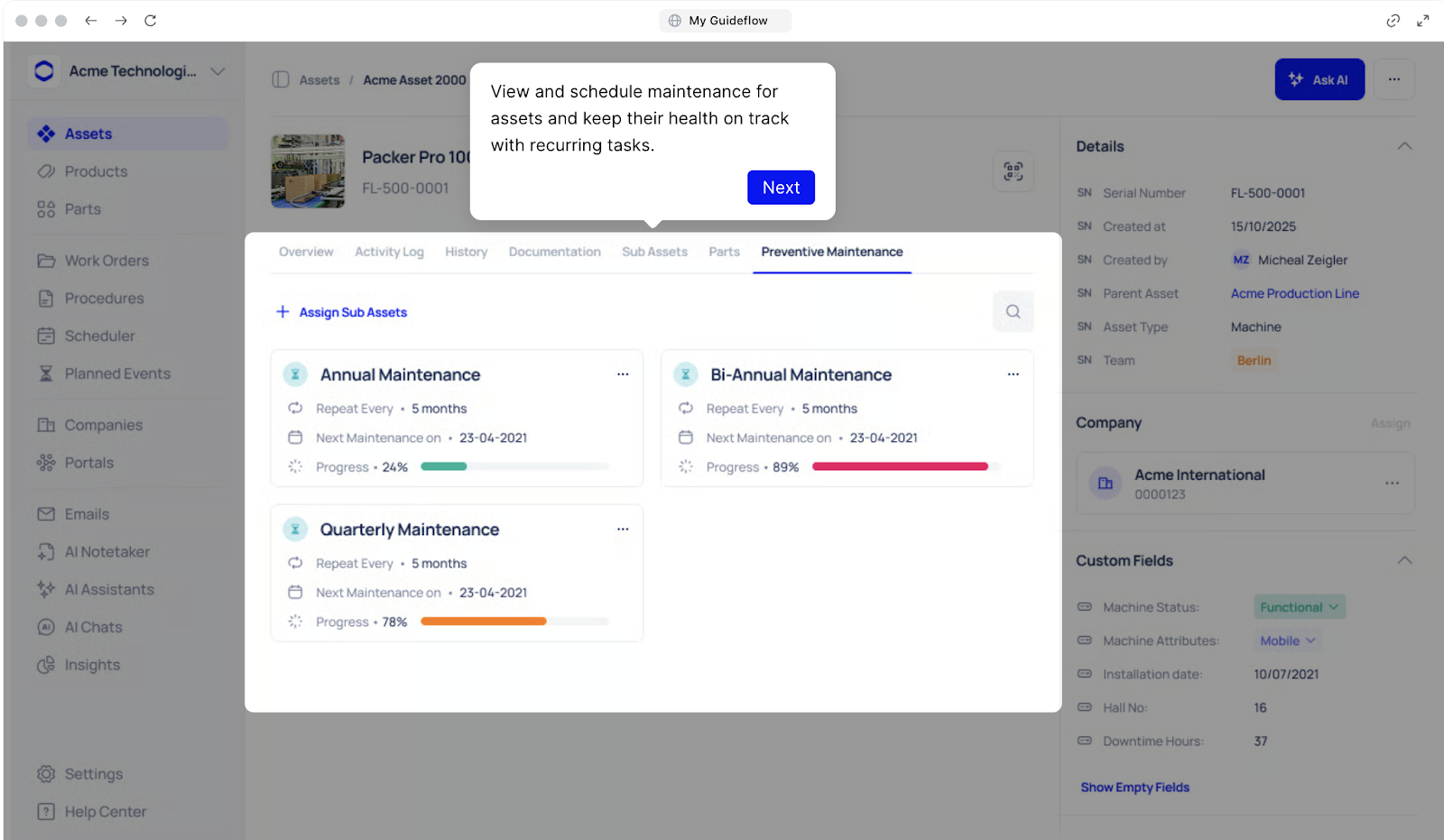
Missed tasks are the most common reason preventive programmes fall short. Technicians get pulled into reactive work, and scheduled services slip through the cracks because no one is tracking them in real time.
Makula automates task creation based on time intervals or equipment usage thresholds. When a packaging line hits 5,000 cycles, the system generates the work order and assigns it to an available technician.
- Schedule daily, weekly, or monthly tasks with automatic reminders
- Trigger maintenance based on operating hours, cycles, or meter readings
- Drag-and-drop assignments through calendar and Kanban views
- Filter by technician availability to avoid double-booking
- Reshuffle priorities when urgent work comes in
Your maintenance schedule stays aligned with how your machines actually run, not just what the calendar says.
Mobile Work Orders for Real-Time Shop Floor Visibility
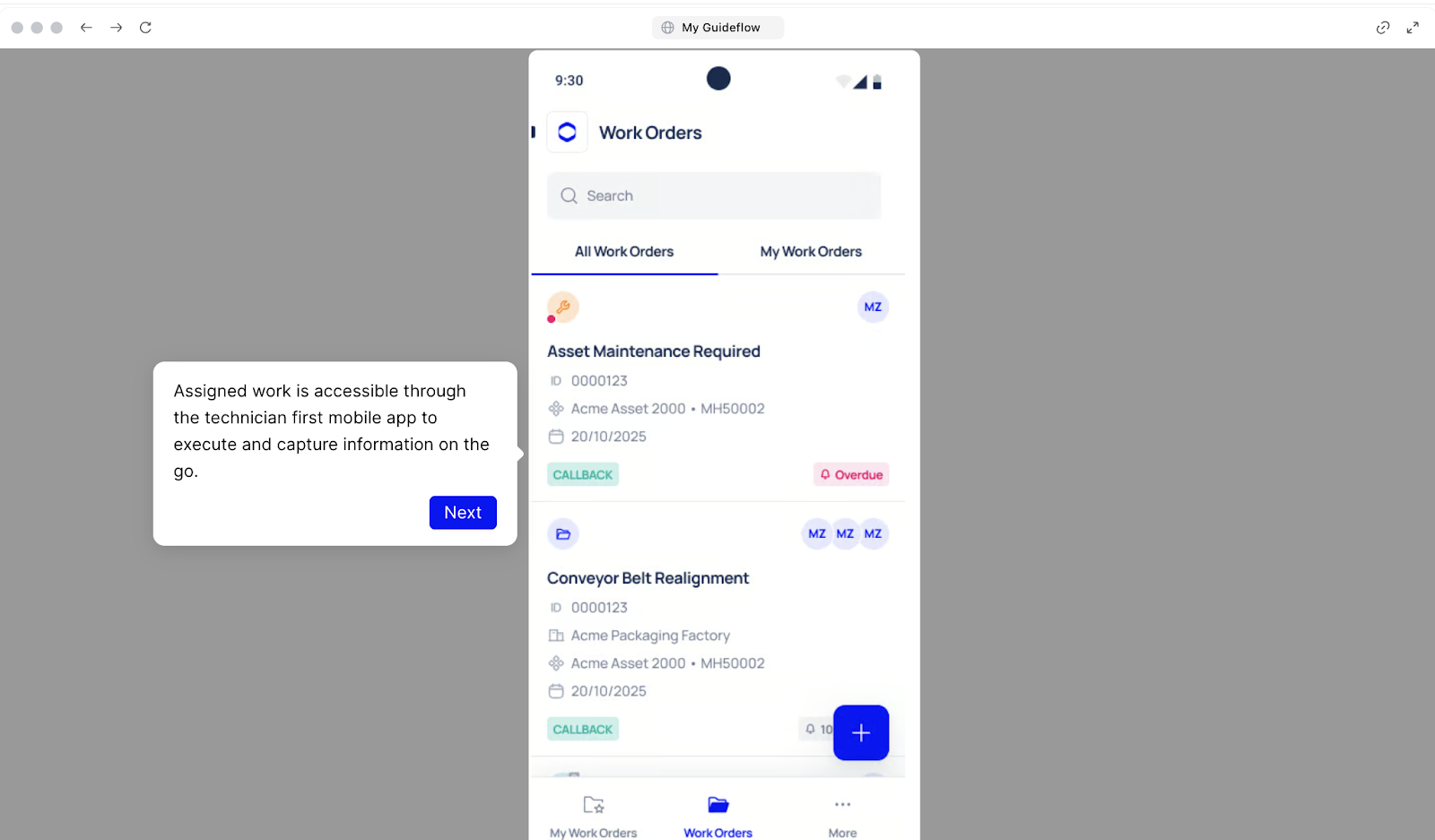
When work orders live in spreadsheets or on whiteboards, technicians waste time walking back to the office for updates. Managers lose visibility into what's in progress and what's overdue.
Makula's work order system runs on mobile devices, giving technicians full access from the shop floor, even when offline.
- Create, assign, and track tasks from any device
- Move jobs through stages using Kanban boards: Scheduled, In Progress, Completed
- Every work order links back to the asset, building a complete maintenance history
- Attach notes, photos, and time logs directly to the job
- Managers see open, overdue, and completed work across teams in real time
Technicians spend less time on admin and more time on the equipment that needs attention.
Digital Checklists to Eliminate Missed Inspections
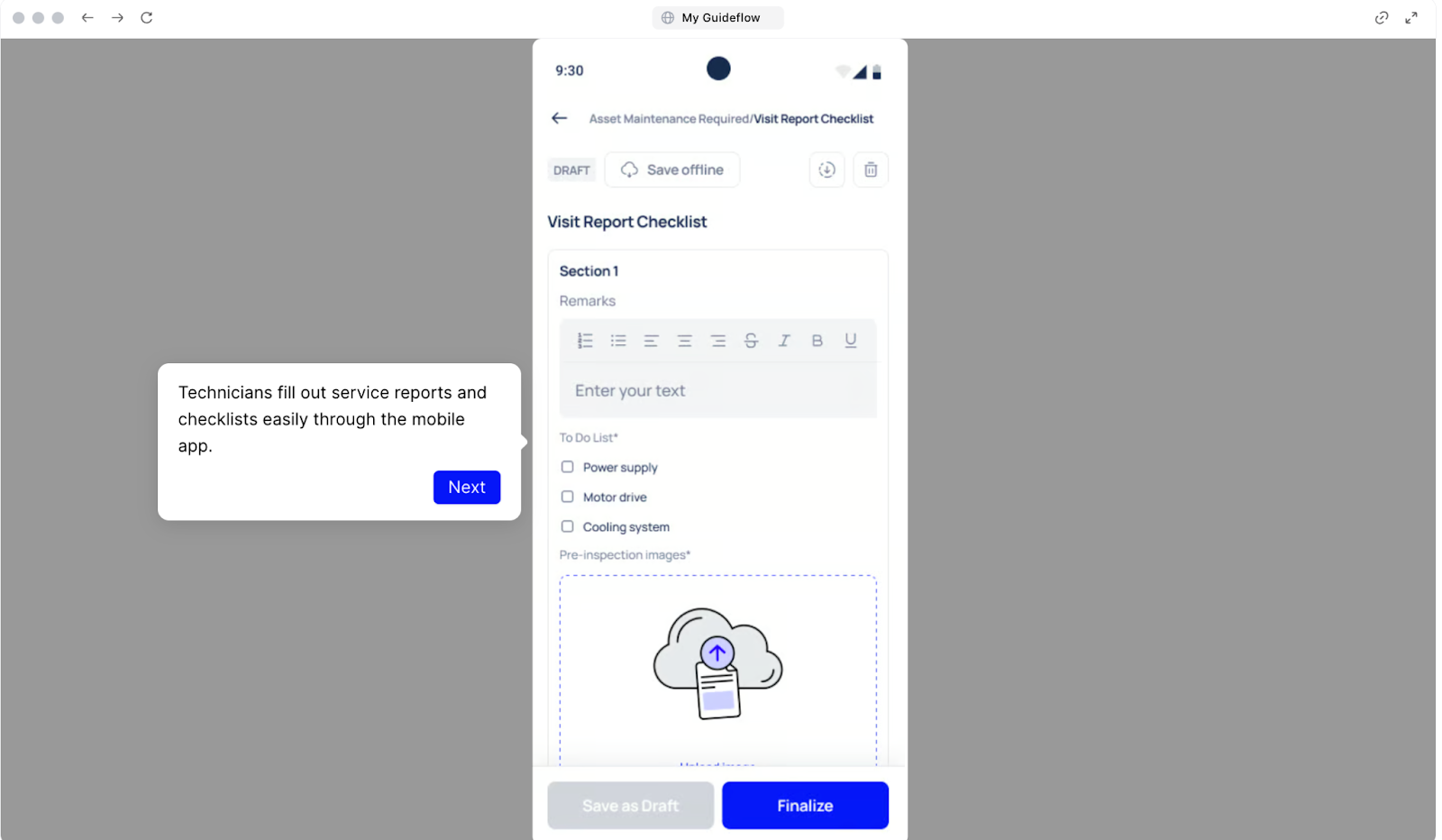
Paper inspection forms get lost, skipped, or filled in from memory at the end of a shift. Managers can't verify whether inspections were actually completed or just ticked off.
Makula's digital inspection forms guide technicians step by step through each task, with mandatory fields that prevent skipping.
- Attach photos, log readings, and sign off digitally from any device
- Every entry is timestamped and linked to the specific asset
- Completed checklists sync automatically when connectivity returns
- Supervisors get notified for follow-up and compliance review
The more specific your checklist steps are, the better your data gets. Instead of "check belt tension," a step like "check belt tension, acceptable deflection: 10–15mm" helps technicians make faster decisions and gives you more useful trends over time.
AI Copilot for Instant Access to Equipment Documentation
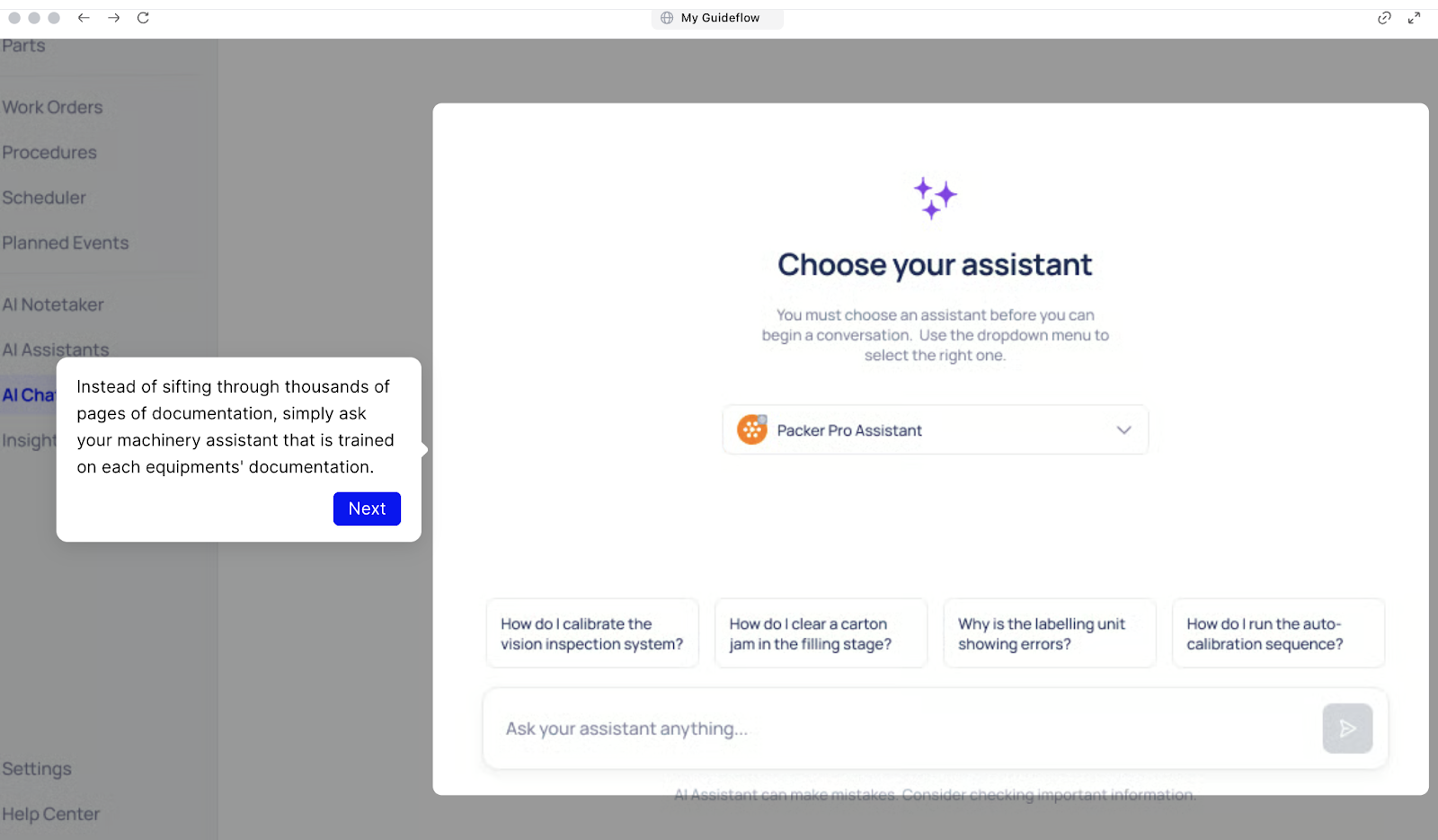
New technicians spend time calling colleagues or searching through filing cabinets when they encounter unfamiliar equipment. That slows down repairs and creates a dependency on senior staff.
Makula's AI Copilot pulls cited answers directly from equipment manuals, service histories, and troubleshooting guides. Technicians type a question and get a sourced answer in seconds.
- Answers are cited from actual documents, not AI-generated
- Click on any source to preview the original document
- Highlighted sections show exactly where the answer came from
- Supports multiple languages for diverse maintenance teams
- Reduces dependency on veteran technicians for routine knowledge
For example, a technician servicing a hydraulic press for the first time can type "what's the recommended fluid viscosity for Model X at 40°C?" and get the exact specification pulled from the OEM manual, with a link to the source page. No phone calls, no guesswork.
Spare Parts Inventory That Keeps Up with Your Schedule
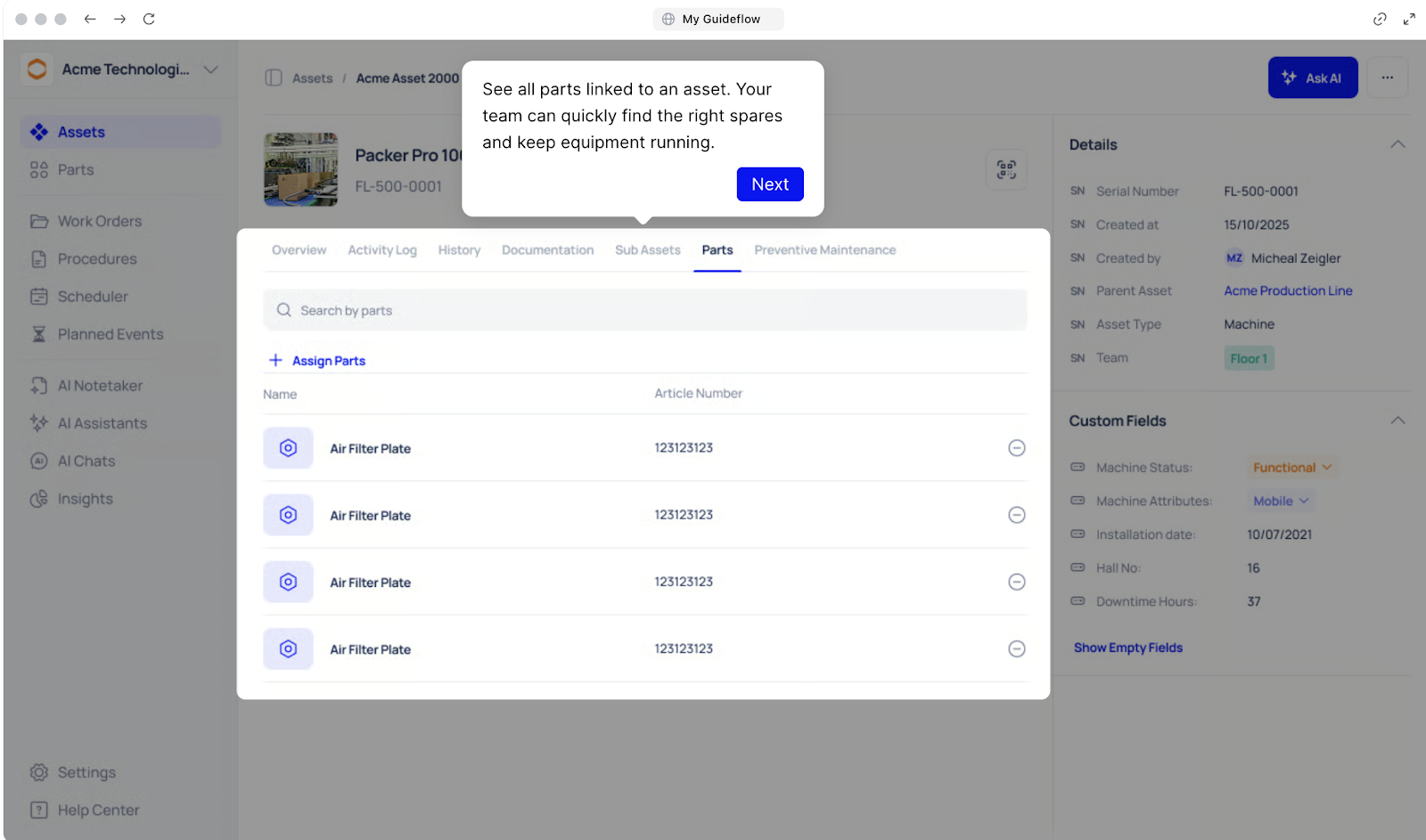
A scheduled maintenance task means nothing if the replacement part isn't in stock. Stockouts turn planned work into deferred work, and deferred work turns into breakdowns.
Makula's parts and inventory module tracks consumption, automates low-stock alerts, and links parts directly to assets.
- Automatic stock updates when technicians log parts usage
- Low-stock alerts trigger before you run out
- Each part is linked to the assets that use it
- Track inventory across multiple storage locations
- Full consumption history for smarter reorder planning
Over time, consumption data shows you exactly which parts each machine uses most. That makes budgeting predictable and removes the guesswork from reorder decisions.
Book a demo to see how Makula automates preventive maintenance scheduling, digital inspections, and work order tracking for your factory.
Case Study: How Dogtooth Technologies Streamlined Preventive Maintenance with Makula
Dogtooth Technologies is an agricultural robotics company that builds automated fruit-harvesting systems. Their fleet of robots operates across multiple customer sites, with each machine requiring consistent preventive maintenance to perform reliably in the field.
The Challenge
Dogtooth's maintenance data was scattered across more than 10 Google Sheets and various document folders. Daily checks on the robots were informal and unrecorded.
Tracking repairs, preventive tasks, and fault reports across multiple sites was slow and error-prone. When something broke, the team spent time searching for maintenance histories instead of fixing the issue.
The Solution
Dogtooth implemented Makula to centralise all maintenance information into one platform. The team used it to formalise daily inspection routines, track fault reports with structured data, and manage preventive maintenance schedules across their entire robot fleet.
The Results
Makula saved Dogtooth's engineering team a couple of hours per engineer per day by eliminating phone calls and document searches. Daily checks that were previously informal are now consistently documented, helping the team spot issues early.
Since July 2024, the team tracked 96 tong changes across the fleet, giving them real data on failure rates to proactively adjust maintenance schedules.
Is Preventive Maintenance for Machinery Worth the Investment for Manufacturers?
Unplanned downtime costs manufacturers thousands per hour in lost production, emergency labour, and missed shipments. A structured preventive maintenance programme costs a fraction of that and compounds in value over time.
Every skipped task is a gamble. Every undocumented inspection is a gap your next audit will find. And every experienced technician who leaves without their knowledge being captured is a reliability risk waiting to surface.
Start with your most critical assets. Build routines that match how your machines actually run. Track the results. The data will speak for itself.
Book a demo with Makula to see how your factory can automate preventive maintenance from day one.

.webp)